

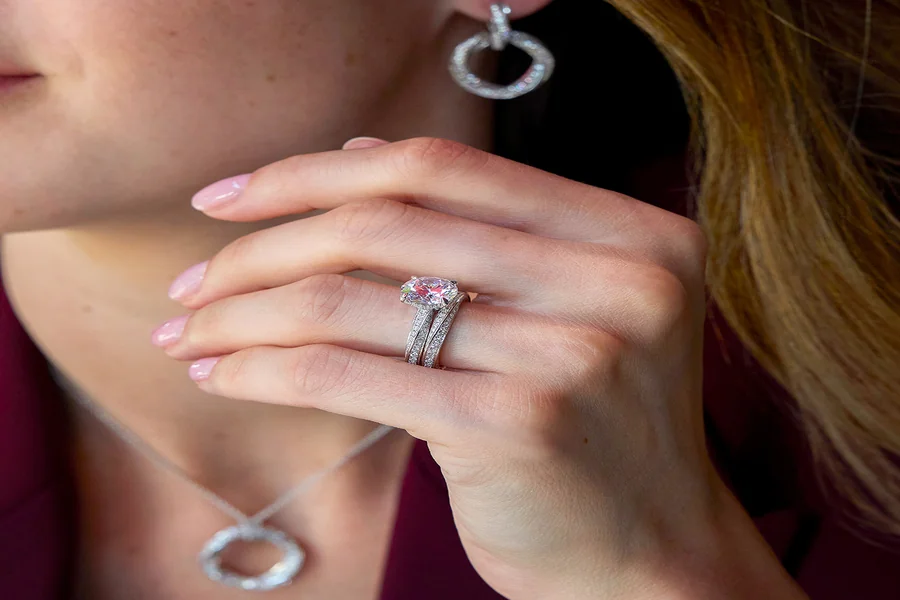
An eternity band can be worn on its own or stacked with a diamond engagement ring, but the combination only works when the combination is right. The way the two rings sit together depends on factors like band width, setting height, and overall design. When these elements align, the rings sit flush and feel comfortable; when they don’t, the stack can feel bulky or misaligned.
Here’s a guide on how to stack an eternity band with an engagement ring.
Start With the Engagement Ring’s Shape
The engagement ring always sets the rules. Its profile, height, and center setting determine what will sit well beside it.
- Higher settings leave room for a full eternity band to sit flush.
- Lower profiles may call for a slimmer band so the rings don’t rub against each other.
- Elongated centers (oval, emerald, marquise) benefit from bands that keep the focus vertical rather than wide.
Choose the Right Band Width
Eternity bands vary widely in width, and this choice does most of the visual work.
Band width plays an important role in how the engagement ring and eternity band work together. A band that’s too wide can compete with the center stone, while a slimmer band frames it beautifully, keeping the focus on the main diamond. Straight bands sit evenly, while curved or contoured bands are created to follow the shape of the engagement ring for a closer fit.
Eternity bands are also available in half and full styles. A half eternity band features diamonds set across the top portion of the band, with designs ranging from uniform stone sizes to tapered arrangements, while a full eternity band is set with diamonds around the entire circumference, creating a continuous look that can be stacked between a wedding band and an engagement ring or worn alone.
Decide Where the Eternity Band Sits
Traditionally, eternity bands sit below the engagement ring, closer to the hand. But tradition isn’t mandatory.
Some prefer the eternity band above the engagement ring, especially when the band has more presence or when it’s added later as one of many anniversary rings. Others alternate depending on mood.
If the rings sit comfortably and don’t rotate constantly, the order is working.
Match Shapes Before Matching Styles
Eternity bands set with baguette or emerald-cut diamonds pair well with engagement rings that have clean lines, such as solitaires or step-cut center stones. Channel-set eternity bands work well with engagement rings that have a slightly lower profile or more structured settings, as the diamonds sit securely within the band. Bezel-set eternity bands are often paired with engagement rings that have rounded edges or softer designs, while shared-prong eternity bands complement engagement rings with more traditional or classic settings.
Consider Comfort, Not Just Appearance
When comfort is a priority, certain eternity band settings tend to feel smoother during daily wear. For instance, bezel-set and channel-set eternity bands are often chosen for everyday wear, as their settings keep diamonds enclosed or flush within the band, creating a smooth surface that sits easily against the finger.
When the Stack Feels Right
A well-styled ring stack is one where the engagement ring and eternity band sit securely together. The rings should feel stable on the finger, maintain their position during regular wear, and remain comfortable over extended periods.
When an eternity band for women is chosen with proportion and comfort in mind, it becomes less about styling and more about habit. And that’s when it truly belongs—right where it is.
