

Science fiction, with its blend of imagination, technology, and futuristic concepts, often challenges our understanding of reality, existence, and morality. At its best, sci-fi pushes boundaries, forcing us to confront profound philosophical questions about the nature of consciousness, free will, and the meaning of life. Sci-fi dialogues, often delivered in moments of tension or revelation, encapsulate these complex themes in ways that leave us questioning everything we thought we knew.
In this article, we explore some of the most philosophical sci-fi dialogues that will make you pause, reflect, and reconsider the world around you. These quotes have a way of lingering in your mind long after you’ve heard them, sparking debates and introspection on the deepest aspects of our existence. Visit Dialogue Express for regular updates on trending movies.
“What is real? How do you define real?” – Morpheus, The Matrix (1999)
One of the most iconic and mind-bending sci-fi films of all time, The Matrix raised profound philosophical questions about reality, perception, and the power of the human mind. Morpheus, portrayed by Laurence Fishburne, delivers one of the most memorable and unsettling lines in the film: “What is real? How do you define real?”
This question is not just about the physical world around us; it delves into the very nature of existence and consciousness. Morpheus asks Neo to question his perceptions, pointing out that what we consider “real” might only be a product of our minds, shaped by sensory input and illusion. This line forces us to examine the assumptions we make about reality and whether what we see, feel, or experience is truly reflective of the world, or merely a simulation of it.
It challenges the very essence of subjective vs. objective reality, prompting a deeper investigation into the mind’s role in shaping the universe we experience. If we can’t trust our senses, can we trust anything at all?
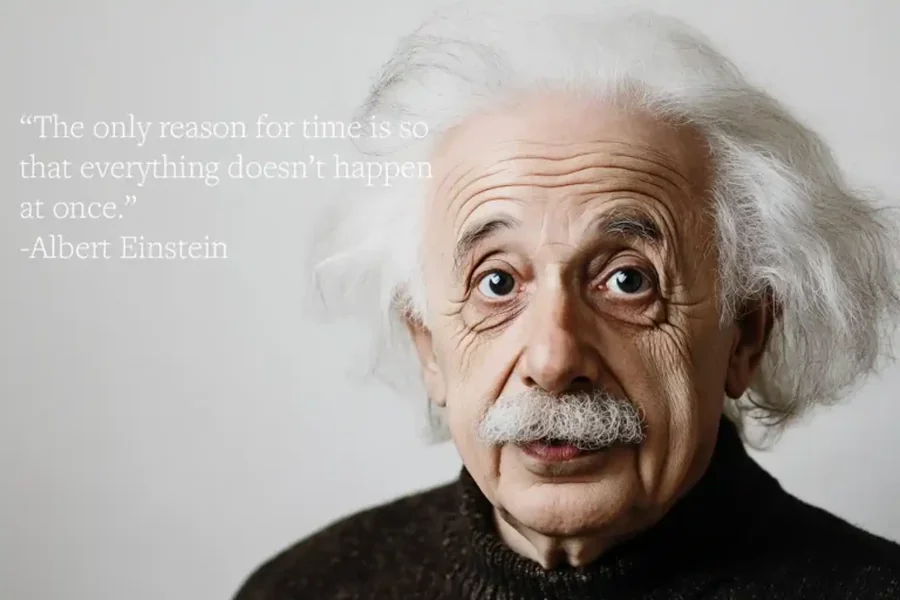
“The distinction between the past, present, and future is only a stubbornly persistent illusion.” – Albert Einstein, Interstellar (2014)
In Christopher Nolan’s Interstellar, the lines between time, space, and perception are blurred as the characters traverse the boundaries of the cosmos. One of the most thought-provoking moments occurs when Matthew McConaughey’s character, Cooper, encounters the concept of time in a way that transcends human understanding.
The film references a line often attributed to Albert Einstein: “The distinction between the past, present, and future is only a stubbornly persistent illusion.”
This dialogue draws on Einstein’s theory of relativity, which suggests that time is not an absolute and unchangeable force. Instead, time is malleable, affected by gravity and speed, and it exists differently depending on your point of view. In Interstellar, time becomes a central theme as Cooper and his team travel to distant planets where time behaves in radically different ways. The line reflects the film’s central philosophical question: if time is not linear, does it even exist in the way we think it does?
This dialogue forces us to reconsider our temporal limitations and the concept of fate. If the past, present, and future are all intertwined, does it mean that our actions are predetermined, or do we still have the ability to shape our own destinies?
“I think, therefore I am.” – René Descartes, Blade Runner (1982)
In Ridley Scott’s Blade Runner, the question of what it means to be human is explored through the interactions between humans and synthetic beings called replicants. One of the central themes of the film is the nature of consciousness—what it means to be alive and to have awareness.
During an emotional confrontation with Roy Batty (played by Rutger Hauer), the line “I think, therefore I am” is echoed, a philosophical concept first introduced by René Descartes in the 17th century. Descartes’ famous declaration suggests that thinking and self-awareness are the core elements that define existence. It is through our ability to think and doubt that we prove our own existence.
In Blade Runner, this question of self-awareness is central to the replicants’ struggle. They have memories and emotions, but are they truly alive? Are they real? This line challenges us to confront the essence of humanity and consider whether true existence is determined by biological origins, or if it can be achieved through the ability to think and experience.
“The only way to deal with this life meaningfully is to find one’s passion, to take action, and to commit.” – The Man from Earth (2007)
In the indie film The Man from Earth, a group of university professors sits around listening to a man named John Oldman reveal a staggering secret—he has lived for over 14,000 years, having been alive since prehistoric times. The film is a deep philosophical exploration of immortality, the meaning of life, and human progress.
During a key moment, John says: “The only way to deal with this life meaningfully is to find one’s passion, to take action, and to commit.”
This dialogue speaks to the heart of human existence: how do we give meaning to a life that is finite and full of uncertainties? For John, the secret to survival and fulfillment over centuries was finding purpose and pursuing his passions. The film suggests that, rather than becoming paralyzed by the inevitable passage of time or the vastness of existence, we should focus on living authentically and making meaningful connections in the present. This quote reminds us that action and commitment are what give our lives purpose and direction, even in the face of immortality or uncertainty.
“It’s not about the money. It’s about sending a message.” – The Joker, The Dark Knight (2008)
In The Dark Knight, Christopher Nolan’s exploration of chaos, morality, and justice reaches its apex in the Joker’s complex philosophical stance. In one of the film’s most iconic lines, the Joker declares, “It’s not about the money. It’s about sending a message.”
This seemingly simple line carries profound implications. The Joker isn’t motivated by wealth or material gain—his purpose is much deeper and more anarchic. He wants to disrupt societal norms, challenge authority, and make people question their values. He believes that human beings are inherently chaotic and that societal structures are fragile.
This line raises a series of philosophical questions about order vs. chaos, morality, and the nature of justice. The Joker’s actions suggest that, in a world where order and morality are imposed by society, true freedom comes from chaos. He forces us to confront whether our ethical systems are constructs designed to control us, and if anarchy might be a truer reflection of human nature.
“Do you feel in control?” – The Matrix Reloaded (2003)
Another unforgettable line from the Matrix series comes from the character of the Architect, the creator of the Matrix. When Neo meets the Architect in The Matrix Reloaded, the architect asks him, “Do you feel in control?”
The question is more than rhetorical. It forces Neo (and the audience) to consider the idea of free will and control within a universe that is potentially pre-programmed. The Matrix itself is a metaphor for how society, culture, and systems of power can dictate our thoughts, actions, and beliefs.
The Architect’s question suggests that what we perceive as free will might be an illusion—like the Matrix, life might be constructed and predetermined by forces beyond our understanding. This question forces us to ask ourselves: How much control do we really have over our lives, and what happens when we realize we may not be as free as we think?
“The future is already here – it’s just not very evenly distributed.” – William Gibson, Snow Crash (1992)
In William Gibson’s influential cyberpunk novel Snow Crash, the line “The future is already here – it’s just not very evenly distributed” is a prescient observation about the rapid pace of technological progress and its uneven impact on society.
This quote speaks to the disparities in access to technology, information, and advancements that exist today. Some people live in worlds that are already deeply influenced by cutting-edge technology, while others are left behind, unable to access the benefits of these innovations. The future, as Gibson suggests, is not a singular, collective experience but one that varies widely depending on where you are and who you are.
This dialogue challenges our assumptions about the pace of technological change and questions whether equitable distribution is possible in a world where advancements are happening at an accelerating rate. It forces us to reflect on how we can ensure that progress is shared and accessible to everyone, rather than deepening the divides between the privileged and the marginalized.
Conclusion
Sci-fi has long been a genre that tackles the big questions of existence, knowledge, and humanity’s place in the universe. Whether through the exploration of artificial intelligence, alternate realities, or the boundaries of time and space, sci-fi dialogues often challenge us to rethink the world we live in.
From The Matrix’s unsettling questions about reality to Interstellar’s reflections on time and space, these philosophical quotes don’t just move the plot forward—they force us to confront our deepest fears, hopes, and uncertainties. They inspire reflection on the very nature of life, consciousness, and free will, compelling us to look inward and ask: What does it mean to truly exist? What is our role in a world that might be governed by forces we can barely comprehend?
These sci-fi quotes remind us that while technology may evolve, the fundamental questions of human existence will always be with us, pushing us to examine the very fabric of our reality.
