

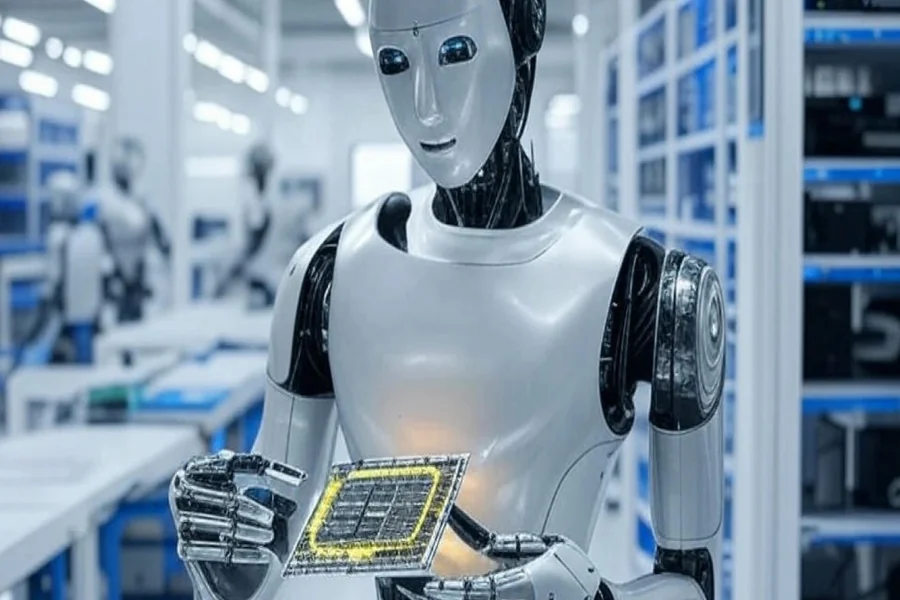
The semiconductor industry faces mounting pressure driven by the need for scale, precision, and interdependence across both design and manufacturing. Decisions made early in development increasingly influence outcomes deep within fabrication, while process variation carries higher consequences for yield and reliability. Erik Hosler, a semiconductor innovation strategist who focuses on linking design intent with manufacturing discipline, highlights how artificial intelligence has become integral to managing complexity across various domains, rather than addressing isolated challenges.
AI stands apart not because of novelty, but because of its breadth. Its influence extends across design automation, process control, inspection, and materials research, connecting workflows that once operated independently. This reach reflects a shift in how semiconductor progress takes shape under sustained technical and operational pressure.
Manual approaches struggle to scale alongside the increasing volume of data and the growing complexity of architectural density. Semiconductor advancement now depends on systems capable of learning from interdependent processes rather than optimizing steps in isolation. AI supports this need by organizing insight across complexity while preserving engineering intent.
From Discrete Improvements to Connected Insight
Semiconductor progress once relied on advances within specific domains, such as lithography resolution or transistor scaling. These improvements delivered measurable gains when systems remained loosely coupled, but as architectures grew more interconnected, isolated optimization produced a diminishing impact.
AI supports a broader analytical view by examining how decisions interact across design, manufacturing, and control. Patterns emerge through correlation rather than isolated metrics. This connected insight changes how success is defined, emphasizing consistency across processes rather than peak performance at a single stage.
Complexity as a Defining Constraint
Modern semiconductor development operates within dense webs of dependency. Chips integrate heterogeneous components, while manufacturing flows rely on tightly sequenced steps. Managing this complexity challenges linear reasoning.
AI assists by processing data at a scale that exceeds human capacity. Models identify relationships that remain difficult to detect manually, supporting earlier recognition of risk and opportunity. Complexity becomes manageable through interpretation rather than simplification.
Aligning Design with Manufacturing Conditions
Design and manufacturing historically progressed with limited feedback between them. Assumptions made during design often encountered friction during fabrication, introducing inefficiency and rework. This disconnect frequently surfaced late in the development cycle, when changes carried a higher cost and limited flexibility.
AI narrows this gap by linking design parameters to manufacturing outcomes through data-driven insight. Feedback from production provides greater clarity for future design decisions. Design intent aligns more closely with operational reality without restricting exploration.
Learning Based Process Control
Process control remains a foundational aspect of semiconductor manufacturing. Traditional approaches rely on static thresholds and predefined models that struggle under advanced node conditions. These methods offer limited visibility into subtle interactions that emerge as process margins narrow.
AI introduces learning into control by adapting to observed behavior. Systems identify early indicators of drift based on pattern recognition rather than fixed limits. Control actions reflect context, supporting stability across variation.
Inspection as an Analytical Signal
Inspection data now carries a deeper meaning than simply identifying defects. At advanced nodes, inspection patterns reveal underlying process behavior. Interpreting these patterns provides insight into the variations that influence performance and reliability.
AI extracts this value by classifying and correlating inspection signals across datasets. Meaningful anomalies separate from expected variation. Insight accompanies detection, strengthening response and understanding.
AI as an Organizational Integrator
Semiconductor development increasingly involves coordination across teams that operate with different priorities and timelines. Design groups focus on architectural goals, manufacturing teams manage process stability, and inspection teams interpret signals that emerge late in the flow.
AI supports integration by providing shared analytical reference points across functions. Data interpreted through common models reduces ambiguity about cause and effect. Decisions reflect evidence visible across teams, rather than assumptions localized within a single domain.
Decision Quality Under Constraint
As semiconductor systems become increasingly complex, decisions are made under tighter constraints of time and information. Engineers face tradeoffs that involve competing objectives across performance, yield, and reliability.
AI assists by structuring decision-making around learned relationships, rather than relying on isolated indicators. Models surface implications that extend beyond the immediate scope. This structured insight supports decisions grounded in system behavior rather than intuition alone.
Knowledge Flow Across the Lifecycle
Semiconductor development spans concept definition, design execution, manufacturing, and validation. Information often becomes fragmented as work progresses between stages.
AI supports continuity by preserving context across this lifecycle. Insights gathered during manufacturing inform earlier decisions without delay. Knowledge flows with fewer interruptions and reduced loss of meaning.
Reducing Dependency on Individual Judgment
Experience remains central to semiconductor work, yet reliance on individual judgment introduces variability. Decisions differ across teams and shifts.
AI reduces this dependency by grounding action in shared evidence. Models reflect accumulated behavior rather than an isolated perspective. Judgment remains essential but operates within clearer boundaries.
When Innovation Depends on Coordination
As semiconductor innovation spans more domains, coordination determines impact. Gains in one area lose value if misaligned with others. Progress depends on synchronization across design, materials, equipment, and control.
This coordination becomes especially important as innovation spans multiple stages of the semiconductor lifecycle rather than isolated technical advances. Erik Hosler emphasizes, “AI-driven tools are not only improving current semiconductor processes but also driving the future of innovation.”
This statement reflects how AI functions as connective tissue rather than a standalone capability. Its value emerges through alignment across design, manufacturing, and control. Innovation gains momentum when insight travels across systems instead of remaining localized.
Data as the Medium of Progress
Data underpins nearly every aspect of semiconductor work. Sensors, simulations, and inspection tools generate continuous streams of information. The challenge lies in converting this volume into understanding that informs timely and consistent decisions.
AI provides the means to connect this data across contexts. Patterns link cause and effect across domains, supporting evidence-based decisions. Progress reflects accumulated learning rather than isolated insight.
Intelligence as Structural Support
Artificial intelligence now functions as structural support within the semiconductor industry. Its role centers on coordination rather than automation alone.
Advancement reflects disciplined integration of insight across domains. AI supports this integration by organizing learning grounded in data. Semiconductor progress increasingly depends on this capability to navigate complexity with clarity and control.
